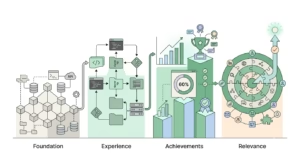
Navigating the Next Phase of Quality Engineering
For many years, software testing was largely associated with manual validation—executing test cases, identifying defects, and ensuring features behaved as expected. While these responsibilities remain important, the role of a quality professional has evolved significantly.
Today’s engineering organizations expect QA professionals to think beyond testing and contribute directly to the engineering ecosystem. This shift has given rise to the Software Development Engineer in Test (SDET) role—a blend of software engineering and quality assurance focused on building scalable solutions that improve product quality.
Why the Shift is Necessary
Modern development teams release software faster than ever. Agile delivery, CI/CD pipelines, microservices, and cloud-native architectures have made manual testing alone insufficient to keep pace with business demands.
Organizations need quality engineers who can:
- Automate repetitive validation tasks
- Build and maintain testing frameworks
- Integrate quality checks into deployment pipelines
- Improve release confidence through engineering solutions
- Leverage AI and data to increase testing efficiency
As a result, the career path for testers is no longer limited to manual validation. The future belongs to engineers who can combine quality expertise with technical depth.
Stage 1: Building Strong Testing Foundations
Every successful SDET starts with a strong understanding of testing fundamentals.
Before learning automation tools or programming languages, it is important to understand:
- Requirement analysis
- Test design techniques
- Defect management
- API validation
- Database testing
- Functional and regression testing
A tester who deeply understands business workflows and risk areas will always build better automation than someone who focuses only on tools.
Stage 2: Learning to Think Like a Developer
The biggest transition for many testers is becoming comfortable with programming.
Learning a language such as Java or Python opens the door to automation, framework development, and engineering collaboration. More importantly, programming teaches problem-solving and logical thinking.
Key concepts to focus on include:
- Variables and data structures
- Object-oriented programming
- Functions and classes
- Exception handling
- Design patterns
- Version control using Git
The goal is not to become a full-time backend developer but to become technically capable of building reliable testing solutions.
Stage 3: Moving into Automation Engineering
Once programming fundamentals are in place, the next step is automation.
Automation should not be viewed as replacing manual testing. Instead, it should free testers from repetitive validation and allow them to focus on exploratory testing, risk assessment, and quality strategy.
Common areas include:
- UI automation using Playwright or Selenium
- API automation
- Test data management
- Framework development
- Automated regression suites
At this stage, quality engineers begin contributing code that directly impacts delivery efficiency.
Stage 4: Embracing Quality Engineering
The most successful SDETs eventually move beyond automation and start thinking about quality at a system level.
Quality engineering includes:
- Performance testing
- Security validation
- Production monitoring
- Observability
- Release readiness
- Reliability engineering
Instead of asking, “Does this feature work?”, quality engineers ask, “How do we ensure this system remains reliable at scale?”
This mindset shift is what differentiates automation engineers from true SDETs.
Stage 5: Becoming an SDET
An SDET is not measured by the number of automated test cases they write. Their value comes from building systems that improve quality for entire teams.
Typical responsibilities include:
- Designing automation frameworks
- Integrating testing into CI/CD pipelines
- Conducting code reviews
- Building internal quality tools
- Driving testing standards
- Improving developer productivity
At this stage, quality becomes an engineering problem rather than a testing activity.
The Next Frontier: AI-Assisted Quality Engineering
The rise of Generative AI is creating another transformation in the testing world.
Modern quality engineers can now use AI to:
- Generate test cases
- Create automation scripts
- Analyze defects
- Improve test coverage
- Generate test data
- Accelerate documentation
Rather than replacing testers, AI is enabling quality engineers to focus on higher-value activities while automating routine work.
The future SDET will not only understand automation and engineering but will also know how to effectively leverage AI to improve quality outcomes.
Tester to SDET Transformation Checklist
| Stage | Action Item | Outcome |
|---|---|---|
| Foundation | Learn SDLC, STLC, Agile, Defect Lifecycle | Strong understanding of software delivery and testing processes |
| Foundation | Master Test Case Design Techniques | Ability to identify functional gaps and improve coverage |
| Foundation | Learn API Testing using Postman | Independently validate service-layer functionality |
| Foundation | Learn SQL Basics | Ability to verify backend data and troubleshoot issues |
| Programming | Learn Java or Python Fundamentals | Build coding confidence and problem-solving skills |
| Programming | Practice OOP Concepts | Write maintainable and reusable automation code |
| Programming | Solve 50–100 Coding Problems | Improve logical thinking and debugging ability |
| Version Control | Learn Git & GitHub | Collaborate effectively within engineering teams |
| Automation | Build UI Automation using Playwright/Selenium | Automate repetitive regression scenarios |
| Automation | Build API Automation Framework | Reduce manual API validation effort |
| Automation | Create Reusable Test Utilities | Improve framework maintainability and scalability |
| CI/CD | Integrate Automation with Jenkins/GitHub Actions | Enable automated execution in delivery pipelines |
| Quality Engineering | Learn Performance Testing (JMeter/K6) | Identify scalability and performance bottlenecks |
| Quality Engineering | Learn Logging & Monitoring | Improve production issue investigation capabilities |
| Quality Engineering | Participate in RCA Discussions | Develop system-level quality thinking |
| Engineering | Review Developer Pull Requests | Strengthen code quality and engineering understanding |
| Engineering | Build Internal QA Utilities/Tools | Move from test execution to solution development |
| AI Readiness | Learn Prompt Engineering | Use AI effectively for quality-related tasks |
| AI Readiness | Use AI for Test Case Generation | Improve productivity and test coverage |
| AI Readiness | Use AI for Automation Script Generation | Accelerate automation development |
| SDET Readiness | Design an Automation Framework End-to-End | Demonstrate engineering ownership |
| SDET Readiness | Lead Automation Strategy for a Team | Operate as an SDET rather than an execution-focused tester |
Success Milestones
| Milestone | Validation Criteria |
|---|---|
| Tester | Independently owns feature validation and test planning |
| Automation Engineer | Automates regression suites with minimal support |
| Senior QA Engineer | Owns automation, quality metrics, and release readiness |
| SDET | Builds frameworks, tools, and CI/CD quality solutions |
| Senior SDET | Drives engineering-wide quality strategy and automation adoption |
| AI Quality Engineer | Uses AI to improve quality, productivity, and release velocity |
90-Day Quick Start Plan
| Timeline | Focus |
|---|---|
| First 30 Days | Programming, SQL, API Testing, Git |
| Next 30 Days | Playwright/Selenium, Automation Framework Basics |
| Next 30 Days | CI/CD Integration, AI-Assisted Testing, Framework Enhancements |
Rule of Thumb:
If most of your time is spent executing test cases, you’re a Tester.
If most of your time is spent building systems that improve quality, you’re becoming an SDET.
Final Thoughts
The journey from Tester to SDET is not about abandoning testing—it is about expanding the scope of impact.
- A tester validates features.
- An automation engineer validates systems at scale.
- An SDET builds platforms and solutions that enable quality across the organization.
As software development continues to evolve, quality professionals who embrace engineering, automation, and AI will be best positioned to lead the next generation of software quality.